
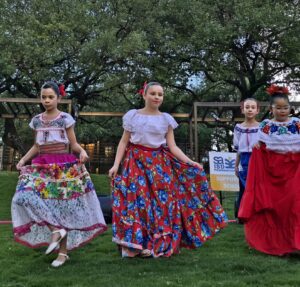
 Before they took the stage on March 24, the youngest dancers in the Bonham Academy Ballet Folklórico smoothed the brims of their cowboy hats and checked the laces on their boots. They were elementary students, ready to perform the foot-stamping rhythms for a downtown San Antonio crowd.
Their older classmates from Bonham — only a grade or two further along — adjusted long skirts that swept the floor in bright florals. None of them looked nervous. Most of them looked proud.
It was the official launch of the SAISD Foundation’s 20th Anniversary — an evening called “A Night of Music. A Legacy of Culture.” And it was a perfect picture of what whole-student support actually looks like.
More Than a Slogan: A 20-Year Practice
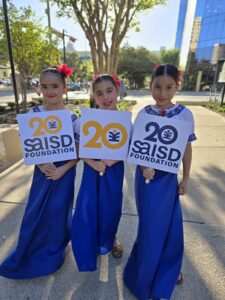
At the SAISD Foundation, “whole student” isn’t a slogan. It’s a 20-year practice. It means an education that treats academic learning, cultural identity, social-emotional development, and a student’s sense of place as inseparable. It means understanding that for the nearly 90 percent of SAISD students who identify as Hispanic, cultural identity isn’t an enrichment add-on. It’s part of an academic foundation.
It’s the reason a third-grader at Bonham Academy is learning regional dances in the same week he’s learning fractions. It’s why a middle schooler at Harris can pick up a guitarrón at the same campus where she’s preparing for the STAAR. It’s why for 20 years, we’ve built everything around a single North Star: putting students first.
“Education equity is about what happens both during the school day and after the bell rings. When SAISD students stay for mariachi rehearsal or folklórico practice, they’re getting an enrichment experience that families in other districts pay for privately.”
Measurable Outcomes: The Academic Case
Ninety-nine percent of SAISD students who participate in mariachi graduate and college enrollment is six percentage points higher than their peers. These are not soft numbers, and they are not coincidences. They are the academic case for whole-student support, made in real outcomes for real students.
The state has caught up. In 2017, the University Interscholastic League officially recognized mariachi as a state-level competition, putting it on the same competitive footing as football, debate, and band. Folklórico isn’t there yet — a statewide petition is pushing for it — but state recognition matters less than the simple fact that thousands of SAISD students walk into rehearsal a few times a week, year after year, and walk out as more confident learners and stronger candidates for the futures they want.
Closing the Funding Gap
As the programs grow larger, our support also continues to grow. Last year, we increased funding to include mariachi instructors at the elementary level — the on-ramp that feeds the rest of the system. This year, we added master classes from professional artists at four campuses.
In the 2024–25 school year, SAISD’s ballet folklórico program was at risk of ending. The COVID-era federal relief funds that had cushioned the district’s enrichment programs were expiring. The Texas legislature did not significantly increase base school funding. The math, district-wide, did not work.
Then the SAISD Foundation stepped in. We paid for part-time dance instructors. We paid for uniforms.
In a single year — between 2024 and 2025 — the Foundation, in partnership with Impact San Antonio, helped expand elementary ballet folklórico from four programs to ten. Hundreds more students stepped into a tradition because donors and partners said yes. District-wide, we now have eight middle school and high school ballet folklórico programs.
In many districts, programs like these exist only for families with budgets for private lessons. At SAISD, they exist for every student. That is what education equity looks like — not just access to enrichment, but outcomes that match the investment.